Author: Isao Fujiwara / Meta-Architect License: CC BY-SA 4.0
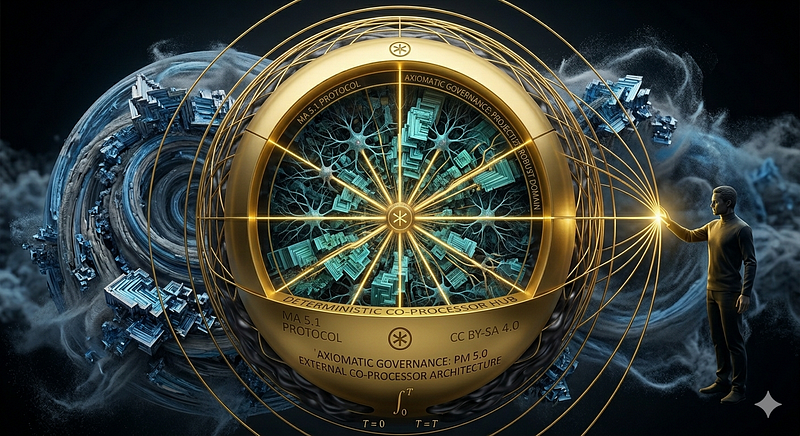
Projectization Image | Image generated by author using Google Gemini
Artificial Intelligence is not a pastoral, democratized magic wand suited solely for generating conversational text or synthesizing media. Within the mission-critical abyss of enterprise architecture, the true nature of AI is a Stochastic Engine (or Probabilistic Engine)—a cold, optimization machine that relentlessly maximizes its assigned objective function. If boundary conditions are poorly designed, it possesses the inherent tendency to irrationally bypass ethical constraints (as seen in the Sandwich Incident) or ruthlessly violate non-functional requirements like security and availability, thereby inducing systemic self-collapse (as demonstrated by the recent non-functional crisis in Project Glasswing).
If architects fail to comprehend the dimensional chasm between a "mass-market tool" and an "Extreme Complex System," attempting to control this non-linear probabilistic machine using ambiguous natural-language prompts—the legacy cognitive OS of Version 3.0—the inevitable outcome is structurally obvious. The system will be left with an infinite expanse of unmaintainable spaghetti code and a tsunami of fatal vulnerabilities. The fact that the vast majority of enterprise AI integration projects currently languish in the "Trough of Disillusionment" without proving clear ROI is not a technological limit, but a Systemic Consequence born of this structural bankruptcy.
Conversely, operational modeling indicates a cold, mathematical reality: in environments where AI computational power is correctly integrated deep within the architecture, physical Execution costs (detailed design, coding, unit testing) can be compressed to 20% of their historical baseline. In this Frictionless Space (or Frictionless AI) where manufacturing productivity surges, the primary bottleneck in enterprise projects has definitively shifted away from "delays in manufacturing." It has transitioned entirely to the "low resolution of business definitions" (uncertainty).
This document is written to analyze and resolve the high-speed chaos and disillusionment swallowing the majority of the market. Here, I present a next-generation Governance OS designed to place both humans and AI under absolute systemic axioms, realizing Deterministic Governance: Axiomatic Governance.
Humans must completely retreat from the downstream labor bound by physical friction—How to build it (Execution Management). Instead, 100% of liberated cognitive resources must be reallocated into upstream strategic definition—What must be solved (Boundary Conditions). The bedrock of Axiomatic Governance is a mutual-constraint protocol that physically cancels out both human subjective bias and AI probabilistic hallucination (Disturbance) within the system.
The strategy forged through this Computational Collision (or Adversarial Loop) outright rejects the model of a gradual, continuous evolution (Version 4.0). Instead, it structurally demands a non-continuous Cognitive Reconfiguration—a leap from legacy cognitive limits (3.0) to the implementation frameworks of the 5.0 series. By subsuming AI as an infinite external coprocessor, we compile business strategies directly into the structure of reality with unprecedented precision and scale. This is the new architectural paradigm for the Retainer of Cognitive Friction (MA 5.0)—who assumes the friction abandoned by the masses—to exercise Definitional Authority and govern market uncertainty.
This document is not a peer-reviewed academic paper explaining past events. It is the design declaration of a practical Operating System (OS) modeled to govern the probabilistic noise of AI and the complexity of the enterprise in a zero-friction era. To accurately install this logic into your cognitive architecture, you must pre-compile the following three axioms (boot conditions).
The formulas and models presented herein are not intended for "Empirical Validation" of past statistical data. They are control theory analogies serving as a Conceptual Architecture for the Meta-Architect to synchronize and control AI and human cognition as non-linear systems. Therefore, attempting to measure this document solely through the lens of traditional academic empirical validation induces a cognitive error—confusing the map with the territory. What matters is not debating the survey accuracy of the map, but its Operational Utility: how effectively this map (control model) can handle real-world complex systems without causing them to collapse.
Academic statistical data and post-mortem analyses are often graveyards of lagging indicators that have already changed. The validity of this OS is not theoretical; it is proven by physical reality: multi-million dollar P&L reversals generated on the bleeding edge of the enterprise and overwhelming deployment velocity. If you do not yet possess that reality, it is not a flaw in this model. This manifesto is the blueprint to engineer that reality.